Start at the meter
Turn off every tap and appliance, including the icemaker and the irrigation. Find the water meter and look at the small low-flow indicator or the dial. If it moves, water is leaving the system somewhere. If it holds still for fifteen minutes, the leak may be intermittent.
Write down the reading and check again in an hour with nothing running. A change tells you how fast the leak is.
The order of checks
Work from the cheapest test to the most involved.
Meter test
Confirm that water moves with everything off.
Toilet dye test
Add food coloring to each tank, wait fifteen minutes without flushing and look for color in the bowl.
Look and listen
Check under sinks, around the water heater and at hose bibs. Listen for hissing in quiet moments.
Where leaks hide
These are the common spots.
Toilets
The leading silent leak. A worn flapper runs water all day.
Under sinks
Supply stops and traps drip slowly.
Water heater area
Drain valve and relief valve drips.
Outdoor spigots and irrigation
Underground joints and valves.
Behind walls and under floors
The hardest to see, and where detection tools matter.
Clues and the next step
Use the clue you have.
| Clue | Likely place | Next step |
|---|---|---|
| Meter moves, no wet spot | Under the slab, in a wall or underground | Leak detection |
| Colored water in the bowl | Toilet flapper | Toilet repair |
| Warm floor patch | Hot water line under the floor | Call for detection and repair |
| Stained ceiling | Pipe or fixture above | Shut the main and call |
If water is spreading, shut the main valve first.
What not to do
Do not open walls on a guess. Do not ignore a moving meter because the bill looks small. A slow leak under a slab can rot framing and grow mold. Photograph any stains and note the date.
Do not keep running a toilet that you know leaks. Even a small flapper leak wastes thousands of gallons a month.
What a plumber adds
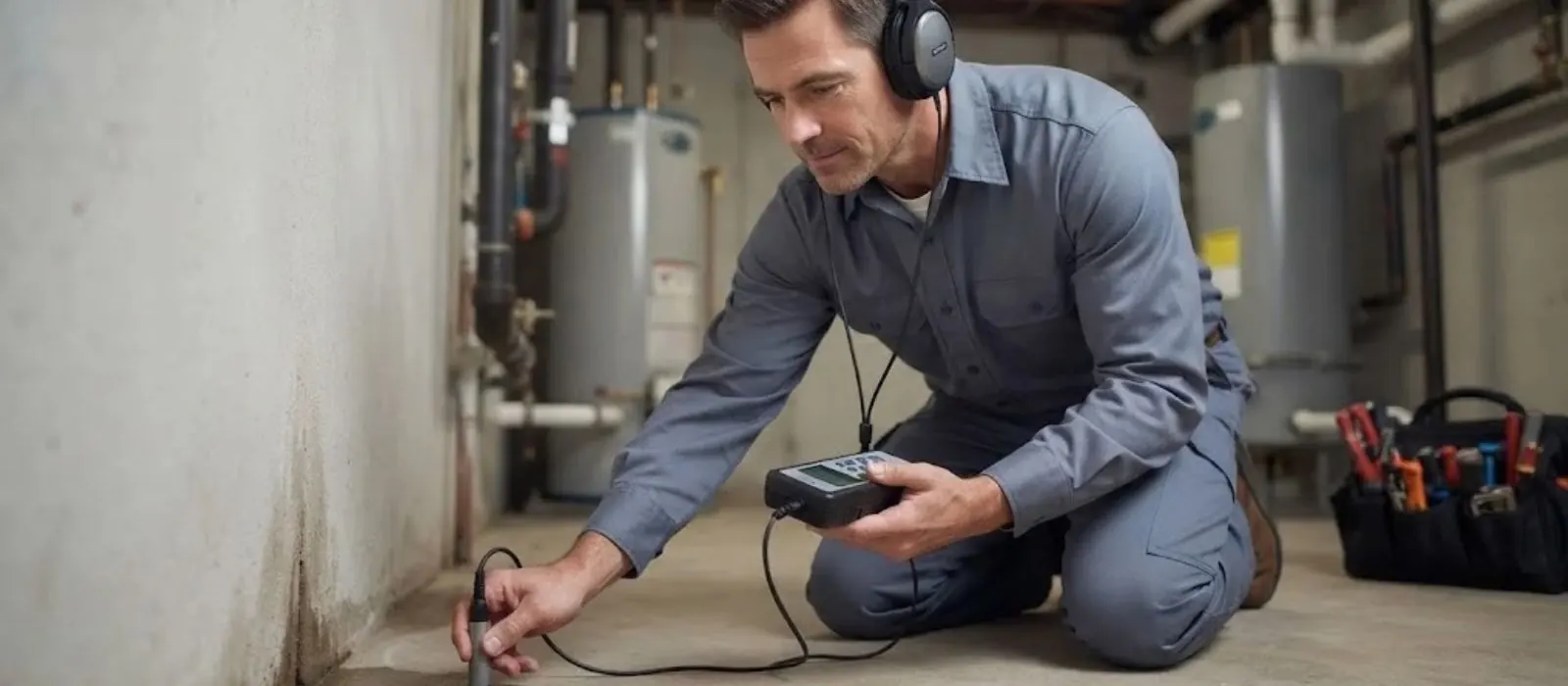
A plumber uses listening equipment, thermal imaging and pressure tests to narrow a leak to a small area. That limits how much has to be opened for repair. The result is a clear report you can give to an insurer.
Insurance and documentation
Many policies cover sudden water damage but not the cost of the leaking pipe. Keep photos, meter readings and receipts. Ask your insurer before you start cleanup, since early disposal of damaged items can complicate a claim.
Reading the meter: a worked example
A homeowner writes down the meter reading at 9 pm, shuts off everything and checks again at 7 am. The number has moved by a few hundred gallons overnight. That is a leak, and a steady one, because nothing in the house was running.
Next the homeowner closes the main valve inside the house and watches the meter. If it still moves, the leak is between the meter and the shutoff, which means the service line. If it stops, the leak is inside the house, and the search narrows to fixtures and pipes.
Common false alarms
Not every moving meter means a broken pipe.
- An icemaker or humidifierBoth fill on their own schedule.
- A water softener rechargeIt uses water at set times.
- Irrigation timersA zone can start while you test.
- A neighbor sharing a lineRare, but it happens with older shared service lines.
The toilet dye test, done properly
Lift the tank lid and put a few drops of food coloring in the tank water. Do not flush. Wait fifteen minutes, then look in the bowl. Any color means water is leaking past the flapper. A toilet can lose a surprising amount of water this way without making any noise.
Repeat for every toilet in the house. Home bathrooms often have a mix of old and new parts, and the oldest toilet is usually the one that leaks. A new flapper is a low-cost part, and replacing it often cuts the water bill.
What the clues say about the age of the leak
Different signs point to different timelines.
Fresh wet spot, no stain
A recent leak. Shut the water and call.
Brown ring on a ceiling
Water has been there a while.
Soft or bubbling paint
Moisture has been behind the wall for days or weeks.
Mold smell with no visible source
A slow leak in a hidden space.
The numbers behind hidden leaks
According to the EPA WaterSense program, the average household wastes nearly 10,000 gallons of water a year to leaks. That is why a quiet meter check is worth a few minutes.
Close every tap and appliance, then look at the leak indicator on your meter. Movement means water is going somewhere. A professional can then pinpoint it without opening more wall than needed.
What to do once you know it is real
If the meter test shows a leak, decide how urgent it is. Water spreading in a room or near electrical equipment is an emergency, and the main valve should be closed at once. A slow leak that shows only on the meter can wait for a scheduled visit, but it should not wait for weeks.
Document what you know. Photograph the meter, write down the readings and the time and note any stains or sounds. If the leak is small, close the main valve overnight and when you leave the house. That costs nothing and stops the loss while you arrange the repair.
Then call a plumber with the facts. A meter that moves with the house off, a warm spot on the floor or a sound of running water each point to a specific kind of search. The more you can say, the faster the plumber can bring the right tools.
Keizer note: rain, floods and wet ground
Keizer sits beside the Willamette River, and the flood display at Keizer Rapids Park marks floods in 1861, 1890, 1943, 1964 and 1996. After a rainy stretch, wet soil can make a slow leak harder to see and can fool you into blaming groundwater. The meter test works either way.
The City of Keizer publishes an annual water report for its groundwater system. If your bill jumps, ask the city for your usage history and compare it with the meter. We also help homeowners in Woodburn and Silverton.
House leak questions
The leak may be intermittent, like a toilet that refills now and then. Run the dye test and check again over a day.
You can spot the signs, such as a warm floor or a moving meter. Finding the exact point needs equipment.
Ask the City of Keizer about your usage history and meter readings.
If water is spreading or near electrical, yes. Shut the main and call. A slow leak can wait a day but should not wait long.
Yes. Closing the main when you sleep or travel is a safe way to stop a hidden leak until it is found. Open it to use water.