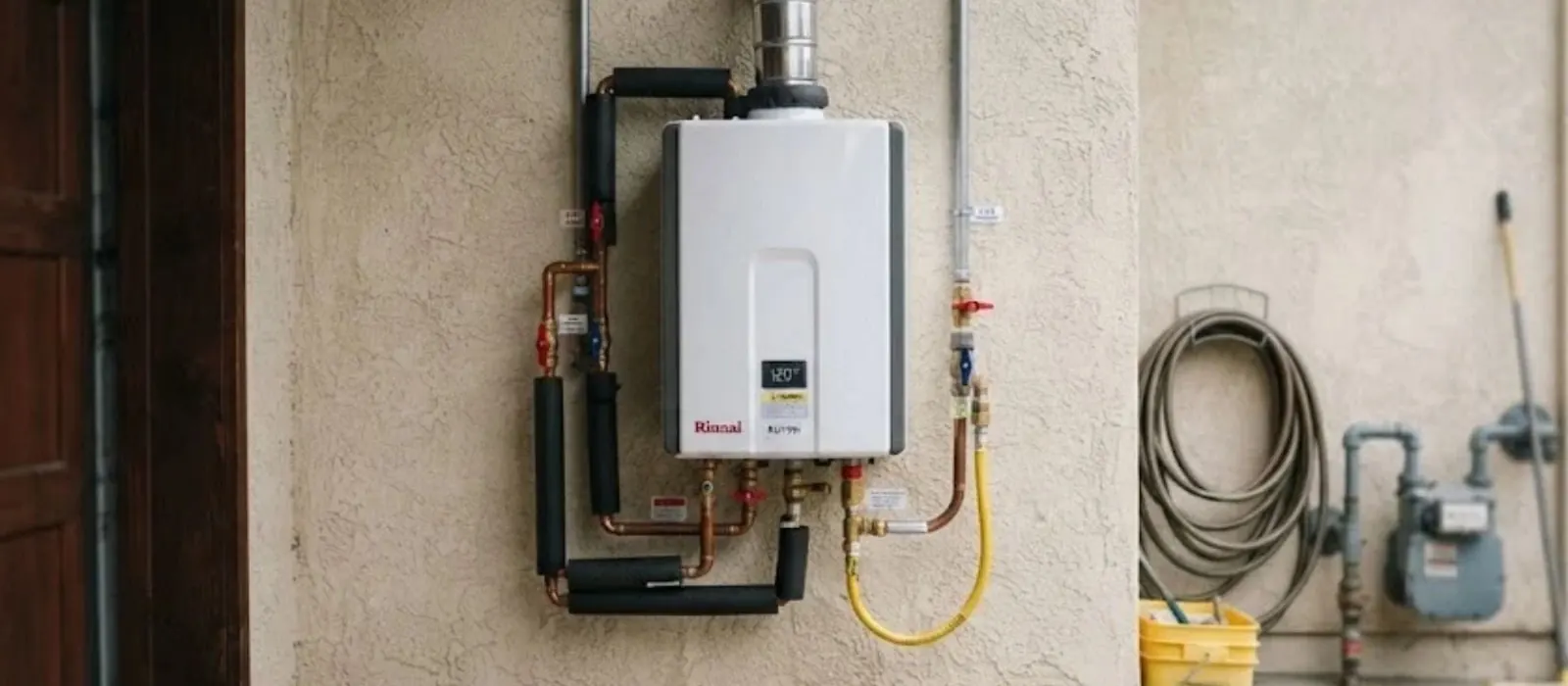
Two numbers decide everything
Tankless sizing comes down to flow rate and temperature rise. Flow is how many gallons per minute the shower uses. Temperature rise is the difference between the cold water coming in and the hot water you want. A shower head that uses less water needs a smaller heater.
Cold incoming water in winter makes the rise larger, so the same unit that works in July may struggle in January. Size for the coldest month.
A quick sizing example
The numbers below are illustrative.
| Factor | Example | Why it matters |
|---|---|---|
| Shower flow | Around 2 gallons per minute for a low-flow head | Lower flow means a smaller unit |
| Desired temperature | About 105 degrees Fahrenheit | Sets the target |
| Winter incoming water | Colder than summer | Raises the temperature rise needed |
| Result | A unit rated for the flow at the rise | Check the manufacturer chart |
Always size from the manufacturer’s capacity chart, not from rules of thumb.
Where one-shower units make sense
These are the usual cases.
Cabins and workshops
A remote shower or washup sink where a tank would be wasteful.
Added bathrooms
A far bath where the main heater is too distant.
Small apartments or ADUs
Limited space and light use.
Point-of-use sinks
Quick hot water at a single tap.
Electric or gas
Small electric units suit a single shower but draw heavy current. Check the breaker and wiring before buying. Gas units need venting and a gas line, which makes them harder for a lone shower in a spare room.
A heat pump or storage tank may serve better if the shower is used often by several people. For options, see water heater installation.
Installation basics
Even a small unit needs care.
Check the supply
Confirm pressure, flow and a place for isolation valves.
Power or gas
Verify the circuit or the gas and vent.
Commission
Set the temperature, test flow and confirm minimum flow fires the unit.
Common problems with small units
Low-flow shower heads can fall below the unit’s minimum flow, so the heater turns off. Mixing valves and long runs add delay. Scale builds up like it does in any tankless unit, so a yearly flush matters. Tankless service covers that.
Cabin, workshop and ADU scenarios
A small unit shines where a tank would waste energy keeping water hot for a shower used a few times a week. A workshop shower, a guest cabin or a small accessory dwelling all fit. The load is light and predictable, and the space is small.
The risk in these cases is the electrical supply. Electric tankless units draw a lot of current, and an older subpanel in a detached building may not carry it. Check the panel before you buy the unit.
Maintenance and water quality
A unit that runs only occasionally can sit with standing water in its exchanger, so flush it on a schedule even if the shower sees little use. Mineral scale does not care how often you shower. If the water has a strong taste or smell after a long idle period, run the hot tap for a minute before use.
Good isolation valves make the yearly flush easy. Ask for them to be installed with the unit, because adding them later means shutting down the supply and cutting pipe.
The minimum flow problem
Every tankless heater has a minimum flow rate below which it will not fire. A shower head rated at a low flow may sit near that minimum. Add a mixing valve and the real flow at the heater can drop below the threshold, so the heater shuts off and the water goes cold.
This is why sizing a small unit means checking both ends of the flow range. The unit must handle the highest flow you will use and still fire at the lowest. Ask the installer to test at the lowest handle setting before leaving.
Options if a tankless unit does not fit
Other ways to serve a lone shower.
A small point-of-use tank
A few gallons of storage near the shower gives steady hot water.
A longer pipe from the main heater
Insulating the line and adding a recirculation loop shortens the wait.
A heat pump or standard tank
A better fit if several people use the shower.
A short planning checklist
Before you buy, write down four facts. The coldest incoming water temperature you expect, the flow rate of your shower head, the temperature you want at the tap and the length of pipe between the heater and the shower. With those numbers in hand, you can read a manufacturer chart and see whether a given unit works.
Then check the supply. For an electric unit, the panel needs breaker space and the wire needs the right size for the load. For a gas unit, the line and the vent must be in place. A unit that is perfect on paper but needs a new service panel is no longer the low cost option.
Finally, plan the shutoffs. A shutoff valve on both the cold and the hot side lets you service the unit without draining the line. It takes a few minutes to add at install time and a lot of trouble to add later.
Keizer note: know your water and your circuit
The City of Keizer supplies water from groundwater wells and publishes an annual water report. Ask for it, or test your tap, to learn about hardness, since scale shortens the life of a small unit. The city page we reviewed gave no hardness number.
If the shower is in an addition or a detached space, ask the Keizer Building Department at (503) 856-3440 about permits for new plumbing and electrical. Properties in Silverton and Salem go through their own city offices.
One-shower tankless questions
Only if its rated flow covers both. Check the chart, and expect the flow to drop if both run at once.
It can. The head must still meet the unit’s minimum flow, or the heater will shut off.
Most shower-sized electric units need a dedicated circuit, not a plug. Confirm before buying.
Permit rules vary by project. Ask the Keizer Building Department at (503) 856-3440.
Water, power or gas, and venting all have code requirements. A licensed plumber and, for electrical work, a licensed electrician should do the work.