Sewer backup: what to do first
A sewer backup is the one plumbing problem you cannot ignore. Our 24/7 line answers day and night, and a plumber is sent as soon as a crew is free. Until we arrive, stop all water use, do not flush toilets and keep kids and pets out of the affected area.
Sewage carries bacteria, so wear gloves and boots if you must go in, and wash well afterward. Do not pour chemical cleaners down the drain, since the plumber may need to open the line.
- Stop all water use. Every drop you add goes toward the backup.
- Do not flush. Toilets share the same line, so each flush pushes more up.
- Keep people out. Block off the wet area and keep children and pets away.
- Locate the cleanout. Knowing where it is speeds up the plumber, and it is often outside near the foundation.
What sewer line repair covers
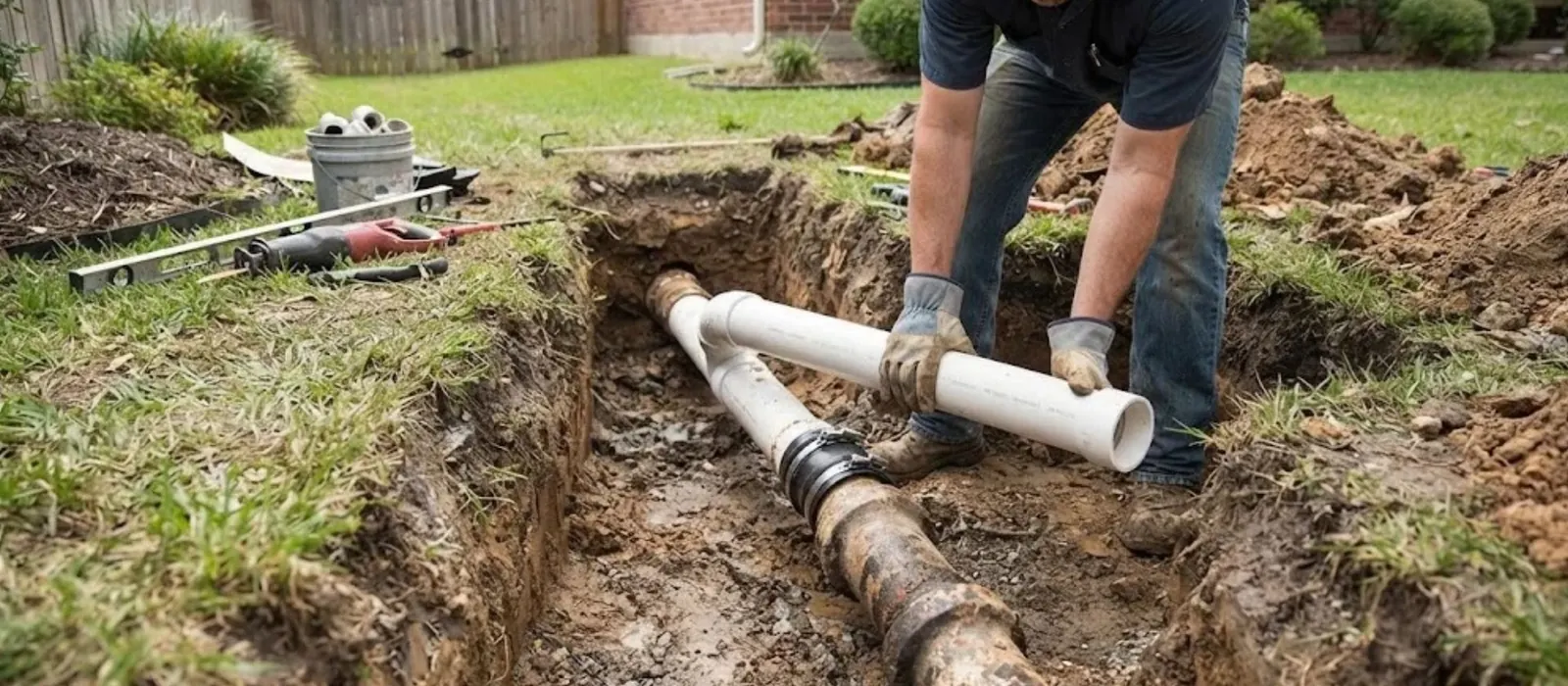
Your sewer lateral runs from the house to the public sewer or septic tank. It can crack, offset at a joint, sag into a belly or fill with roots. Repairs range from spot fixes to full replacement, and the right one depends on what the camera shows.
Before any repair, a camera inspection records the pipe so you see what we see. See sewer inspection for how that works. If the line is just blocked and not broken, sewer line cleaning is the first step.
Signs your sewer line is damaged
Several clues point to the main line instead of a fixture.
Multiple drains slow
When tubs, sinks and toilets all slow together, the main line is the suspect.
Sewer smell outside
A smell near the foundation or yard points to a leak in the line.
Soft or sunken lawn
A wet or sinking patch along the line path suggests a break underground.
Frequent backups
Clogs that return after cleaning often mean roots, a belly or a crack.
Gurgling toilets
Air pushed through traps shows a restriction downstream.
Repair options compared
Each method has a place, and we explain the trade-off.
| Method | Best for | Trade-off |
|---|---|---|
| Spot repair | One cracked or offset section | Needs digging at that spot |
| Trenchless pipe lining | Long runs with cracks or roots, pipe still in line | Needs a clean, intact path, see below |
| Pipe bursting | Collapsed or badly damaged pipe on a straight run | Needs entry and exit pits |
| Open-trench replacement | Severe damage, belly or offset | Most disruptive but most certain |
Which one fits is decided by the camera recording, not by a guess.
Pipe lining for cast iron and older drains
Cast iron drains in older homes can scale, crack and leak at joints. A cured-in-place liner is a resin-soaked sleeve pulled through the pipe and cured to form a new pipe inside the old one. It avoids a trench, but it needs a clear path and a pipe that has not collapsed.
Lining is not right for every line. A severe belly will still hold water inside the liner, and a crushed section has to be dug. We use the camera to decide and tell you plainly if lining will not work.
The repair process
We scope first, then fix.
Camera the line
We run a camera from the cleanout, locate the problem and mark it on the surface.
Choose the method
You see the footage, hear the options and receive a price for each.
Repair and verify
The fix is made, the line is cleaned and a second camera pass confirms the result.
Sewer lines under Keizer lots
Keizer homes from the 1960s and 1970s sit on lots that were farmland and orchards before they were subdivided. Mature trees planted since then often have roots reaching toward older clay or cast iron joints, which is a common root-intrusion pattern. A camera look settles whether roots, age or a shifted joint is behind a repeat backup.
If your property is on septic rather than city sewer, tell dispatch when you call. Septic systems need different service, and we confirm which applies at the start. Nearby customers in Salem and Woodburn can ask about local connection rules with their city.
What sewer line repair costs
Sewer work spans a wide range, so we price it after the camera work.
Digging, permits and code on a sewer repair
Before any trench is dug, call 811, the national call-before-you-dig number, so buried utility lines are marked. Digging into a gas, electric or water line is dangerous and expensive, and the free call is how it is avoided.
Sewer repairs are regulated work. The pipe, bedding, slope and connections must meet the Oregon Plumbing Specialty Code, which is the state’s adoption of the Uniform Plumbing Code (UPC), and most repairs need a permit and an inspection. Ask for the pipe material and the inspection steps in writing before you approve a repair.
Sewer line repair questions from Keizer homeowners
Yes. Dispatch is open 24 hours a day, every day. A sewage backup is treated as urgent, and a plumber goes as soon as a crew is free.
A camera inspection shows cracks, offsets, roots and bellies on video. You see the same footage the plumber does.
Not always. Lining and bursting are trenchless options when the pipe path allows them. The camera decides which is possible.
Ask the City of Keizer where its responsibility ends and yours begins, since that decides who pays for which section.