The principle: leaks make noise
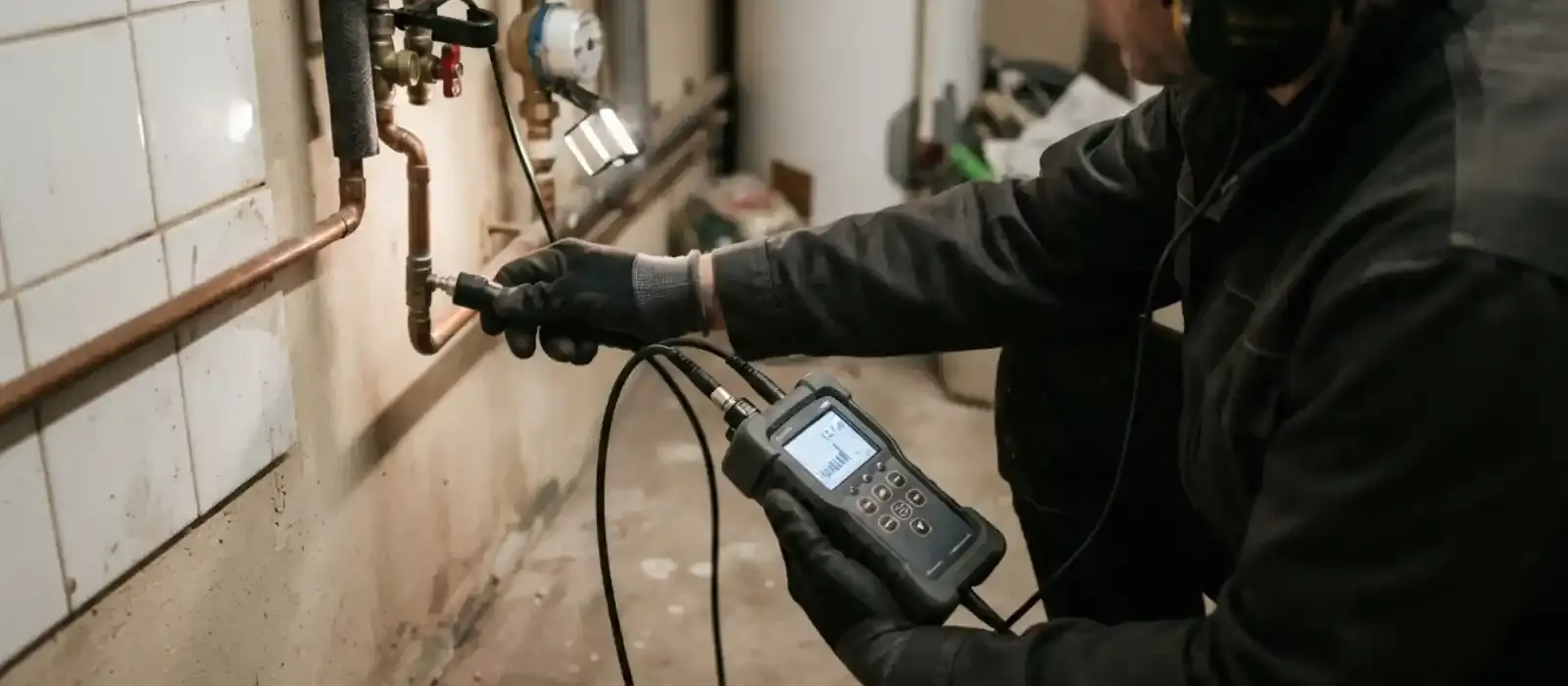
When water escapes from a pipe under pressure, it creates vibration and sound. That noise travels along the pipe and through the ground or the building. An acoustic leak detector uses sensitive microphones and amplifiers to pick it up, even when a human ear cannot.
The technician listens at several points along the line. The place where the sound is loudest marks the likely leak position, which narrows the search to a small area.
Tools in a typical kit
No single tool finds every leak, so detection uses several.
Ground microphone
A sensitive mic placed on soil or concrete to hear buried leaks.
Contact sensors
Clip-on or probe sensors on pipes, valves and meters.
Correlator
Compares sound at two points to calculate the leak’s distance.
Thermal camera
Shows warm spots from hot water leaks. See leak detection.
What helps and what hurts acoustic detection
Conditions change the result.
| Condition | Effect | What the tech does |
|---|---|---|
| Quiet house, low traffic | Helps | Schedule the visit for quiet periods |
| Higher water pressure | Helps | Keep the pressure steady during testing |
| Plastic pipe | Hurts, sound carries less far | Use more test points |
| Thick slab or deep burial | Hurts | Combine with pressure tests |
| Running appliances | Adds noise | Turn off all fixtures and appliances |
Tell the technician about recent plumbing work and known quirks.
A detection visit with sensors
The steps run in order from broad to narrow.
Isolate and test
Fixtures are shut off, the meter is read and the lines are pressure tested in sections.
Listen
The tech places sensors along exposed pipe, at valves and over the suspect run.
Pinpoint and mark
The loudest point is marked, confirmed with a second method and reported to you.
What acoustic cannot do
Sound sensors cannot find a leak in a drain pipe, because drains are not under pressure. A cracked sewer line is found with a camera instead. See sewer inspection.
Very slow leaks make little noise. For those, a pressure test or a long meter test can show that water is lost, and thermal imaging or tracer gas may help locate it.
What to do with the result
A marked location lets the repair be targeted. Instead of opening a whole wall or slab, only a small area needs to be exposed. That saves money and time. The final report also documents the leak for your insurance claim.
If the leak is on the supply line to the house, the fix may be a service line repair, and burst pipe repair covers failed lines inside.
Why the meter test comes first
Before any sensor goes on a pipe, the technician reads the meter with the house shut off. That tells them whether a leak exists, and roughly how big it is. A fast-moving dial points to a large leak that makes a lot of noise. A slow creep points to a small one that may need pressure testing.
Doing the meter test first also keeps the visit efficient. If the dial holds still, the technician does not waste time listening for a leak that is not there.
Honest limits and expectations
Acoustic detection is a skilled craft, and the results depend on the pipe, the soil and the background noise. A good technician tells you how confident they are and confirms with a second method before opening anything.
Be wary of anyone who promises to find every leak every time. The honest promise is a narrowed search area, a clear explanation and a repair plan that opens as little as possible.
Leak noise and what it tells the technician
A pinhole leak has a hissing sound. A larger break has a rushing sound at a lower pitch. The sound changes with pipe material, pressure and the soil or fill around the pipe. An experienced technician learns to tell a leak from other noise, such as a running toilet, a pump or traffic.
Because the sound travels along the pipe, the loudest point at a valve or fitting is not always the leak. That is why a correlator, which compares the arrival time of the sound at two sensors, is useful. It calculates where the sound started, and marks the point for confirmation.
What to do before the visit
A few steps make the search more accurate.
Know your shutoffs
Find the main valve and any zone valves.
Keep the house quiet
Avoid running appliances during the test.
Tell us about repairs
Recent work can explain new noises.
Note the meter reading
It gives us a starting number.
What the report should contain
A good detection report states what was tested, what was found and how confident the technician is. It lists the meter reading before and after, the sections of pipe that were isolated and the point or area where the leak is believed to be. It may include photos of the marked location and the sensor readings.
It should also state the limits. If a section could not be tested, the report should say so. If the signal was weak because of a slab or plastic pipe, that belongs in the notes. An honest report helps you and your insurer understand the result.
Keep the report with your home records. If you sell, a documented leak repair is a reassurance to a buyer. If you file a claim, the report is the evidence that supports the cost of the repair and the access work.
Keizer note: a large pipe network
The City of Keizer reports that its water system uses 15 deep wells and about 125 miles of pipe. Your service line from the city main to the house is a small part of that, and a meter that runs with every tap off tells you the leak sits between the meter and the faucets.
Visitors to Keizer Rapids Park will see the flood display marking floods in 1861, 1890, 1943, 1964 and 1996. Wet soil after rain can hide a slow leak, which is where acoustic tools help. We also serve Salem and Silverton.
Acoustic detection questions
No. It is listening only. Nothing is drilled or cut during the search.
Often, in combination with pressure tests and thermal imaging. Thick slabs reduce signal strength.
It narrows the leak to a small area. Confirmation with a second method is standard before opening anything.
Yes. A moving meter with all taps off shows a leak and guides where to listen.
Most visits take one to three hours. Complex properties with several zones or deep lines can take longer.