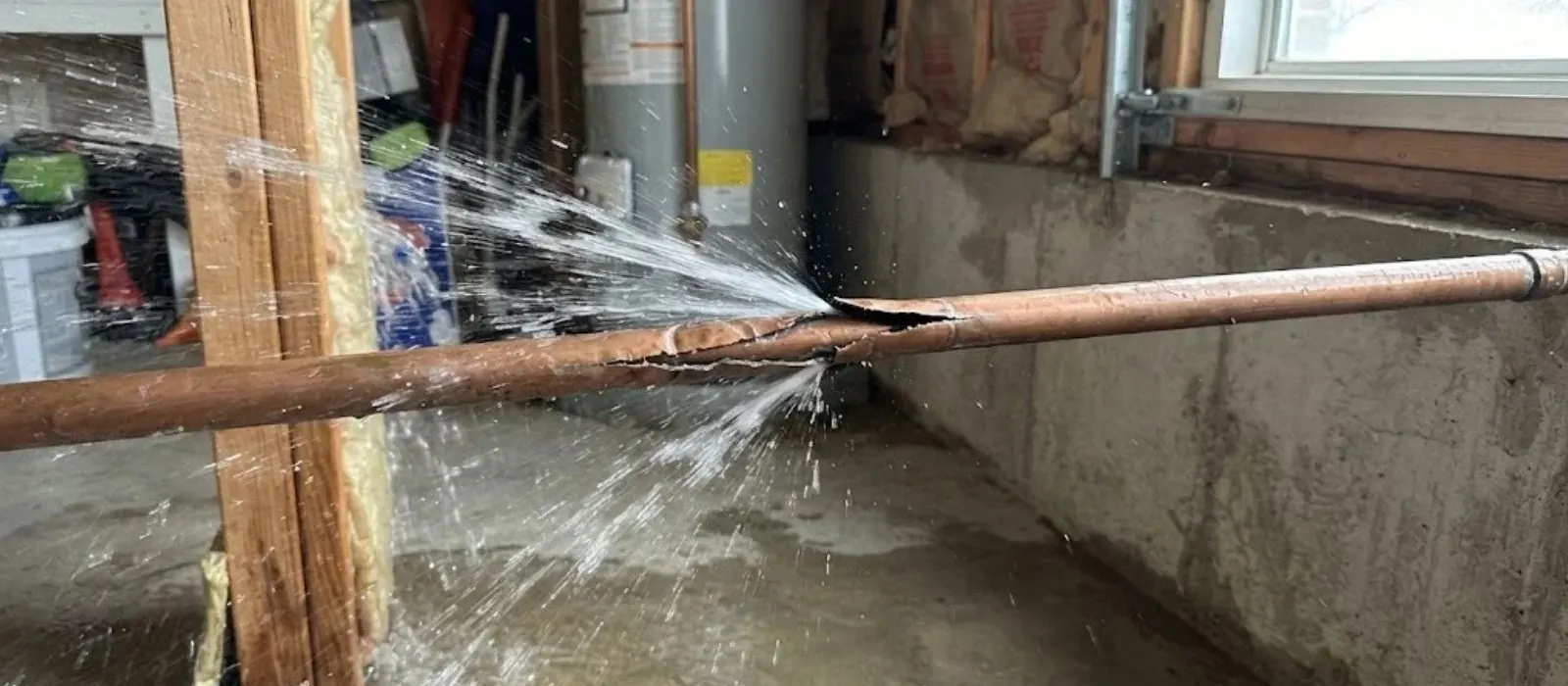
Burst pipe: what to do first
A burst pipe floods a home in minutes. Our 24/7 dispatch answers at any hour and sends a plumber as soon as a crew is free. The first job is yours: close the main water shutoff, usually near the water meter, where the line enters the house or in the garage.
Once the water is off, open the lowest faucet to drain the lines, switch off power to wet rooms only if the breaker is dry and reachable, and call us.
- Close the main shutoff. Turn it clockwise until it stops. If it is stuck, say so on the call.
- Drain the lines. Open the lowest cold tap and flush a toilet to relieve pressure.
- Protect electrical. Stay away from wet outlets and panels, and move valuables to dry ground.
- Photograph everything. Take photos of the break and the damage before cleanup for your insurer.
Why pipes crack or burst
A burst is the end of a slower story. These are the usual causes.
Freezing
Water expands as it freezes and splits pipes in unheated spaces such as crawlspaces and exterior walls.
Corrosion
Old galvanized steel rusts from the inside, thinning the wall until it gives way.
High pressure
Pressure above normal strains fittings, and a failing regulator can cause bursts.
Movement
Shifting soil and settling can crack drain and supply lines.
Faulty fittings
A bad coupling or supply line fails suddenly, often without warning.
How we repair a burst pipe
The repair depends on the pipe and the break. A split in copper or PEX is cut out and replaced with a new section and proper fittings. A failed galvanized section is replaced with modern pipe, since patching old steel often just moves the leak to the next weak spot.
If more than one section has failed, repiping becomes the better option. See repiping for whole-house replacement. When the water source is hidden, leak detection finds the break first.
The repair visit
We stop the water, then fix it right.
Stabilize
The plumber confirms the shutoff, drains the lines and locates the break.
Repair
The damaged section is cut out and replaced with new pipe and fittings, then pressure tested.
Restore
Water is turned back on slowly, fixtures are checked and you get advice on drying and damage.
Which pipe, which fix
The material in the wall changes the repair.
| Pipe material | Common failure | Typical repair |
|---|---|---|
| Copper | Pinhole corrosion or freeze split | Cut out and sweat in a new section or use push fittings |
| PEX | Freeze damage or fitting failure | Replace the section with crimp or expansion fittings |
| Galvanized steel | Internal rust and thinning walls | Replace the section and consider repiping |
| Cast iron drain | Cracks and joint leaks | Sleeve or replace, see sewer line repair |
These are common patterns, not a diagnosis. The plumber confirms the pipe material on site.
Frozen pipes and other seasonal risks
When pipes in an unheated space freeze, you may see no water at a faucet before you see a burst. Turn off the main valve before you try thawing, and never use an open flame. If a pipe thaws and splits, you want the water already off.
Insulate exposed pipes in crawlspaces and garages, open cabinet doors on exterior walls during hard freezes and know where your main valve is before you need it.
Burst pipes in Keizer homes
Many Keizer homes date from the 1960s and 1970s expansion, when the city says orchards and berry fields turned into subdivisions. Homes from those years can have galvanized steel supply lines or older copper, and both fail with age. A visible stain on a wall near an old water heater or a hose bib is worth checking before it becomes a burst.
Ask the City of Keizer Building Department at (503) 856-3440 whether a given repair needs a permit. Permit rules vary by project. If you are in nearby Silverton or Woodburn, the local building office is different, and we help you reach the right one.
What a burst pipe repair costs
The final number depends on the break and the access. These are the factors.
Materials, code and safety after a pipe bursts
Replacement pipe and fittings for drinking water must be materials that the Uniform Plumbing Code (UPC), as adopted in Oregon, approves for potable use. Joints should be made the way the pipe maker specifies, because a bad fitting is a common cause of a second failure.
Safety comes first while you wait. Do not stand in water near outlets, appliances or the electrical panel. If water has reached any of them, leave the area and have power shut off by a professional. Close the main water valve, open the lowest tap to drain the lines and photograph the damage for your insurer.
Burst pipe repair questions from Keizer homeowners
Yes. The line is open 24 hours a day, every day. Shut off the main valve, call, and a plumber is dispatched as soon as a crew is free.
Look near the water meter, where the line enters the house or in the garage. Turn it clockwise until it stops. If you cannot find it, tell dispatch.
One failed section on otherwise sound pipe is a repair. Several failures or corroded galvanized pipe point to repiping, and we explain both.
Often it covers sudden water damage but not the repair of a worn pipe. Take photos, keep receipts and ask your insurer before you file.