What pipe lining actually is
Pipe lining, often called cured-in-place pipe, is a repair that builds a new pipe inside the old one. A flexible tube soaked in resin is pulled or inverted through the damaged pipe, inflated against the walls and cured until it hardens. The result is a smooth, jointless pipe with a slightly smaller diameter.
The method suits sewer laterals and drain lines that are cracked, leaking at joints or invaded by roots, as long as the pipe still holds its shape. It avoids a long trench through the yard, which is why people ask about it so often.
Why cast iron drains fail in older homes
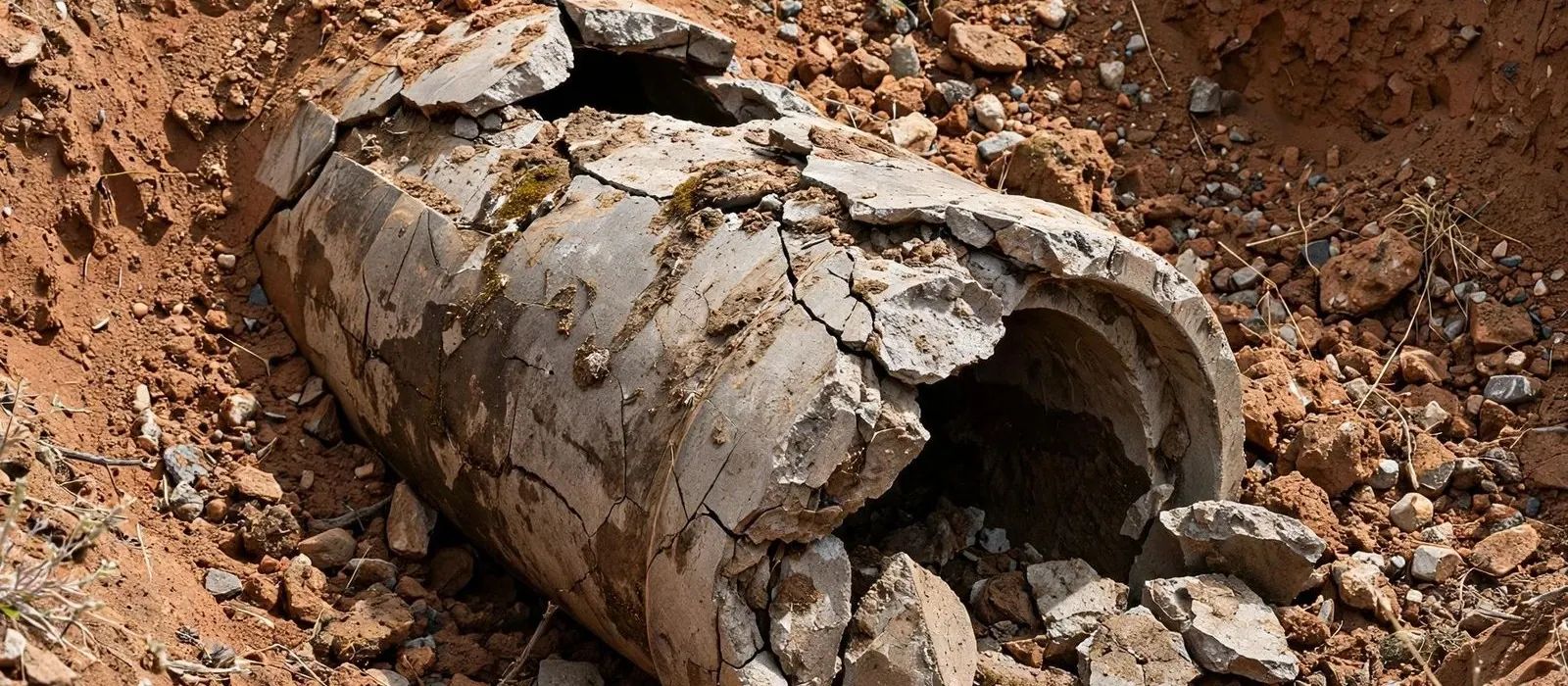
Cast iron lasts for decades, but it does not last forever. Inside, rust scale builds up in rough layers that catch paper and grease. Outside, soil and moisture attack the pipe. Joints made with lead and oakum or hubs can loosen, and a loosened joint lets roots in.
You will often see the same pattern: a line that clogs every few months, a slow gurgle after heavy use and a sewer smell near the foundation. A camera inspection turns that guesswork into a clear picture. See sewer inspection for how it works.
Lining or digging: the fast comparison
Both fixes are legitimate. The right one depends on the pipe.
| Condition | Lining works | Digging is better |
|---|---|---|
| Cracks and open joints | Yes | Only if misaligned |
| Root intrusion | Yes, after cutting the roots | If the pipe is also offset |
| A belly (sag) holding water | No, the sag remains | Yes, regrade the pipe |
| Collapsed section | No | Yes |
| Long runs under a driveway or trees | Often the best fit | Costly and disruptive |
The camera recording decides, not the sales pitch.
How a lining job goes
The process takes a day or two for a typical lateral.
Install the liner
The resin tube is pulled through, inflated and held under pressure while it cures.
Reopen and verify
Branch connections are cut open from inside, and a final camera pass confirms a smooth pipe.
Questions to ask before you hire anyone
Lining is a specialty, so ask these before you sign.
- May I see the camera video?A good contractor shows you the pipe before and after.
- Is the pipe a candidate?Ask why. If there is a belly or a collapse, lining will not fix it.
- What is the warranty?Get the terms in writing and ask what voids them.
- Who pulls the permit?Confirm that a licensed contractor pulls permits where required.
- What about the connections?Lateral connections must be reinstated and sealed.
What lining costs and what drives it
Price depends on length, diameter, access, the number of connections and how much cleaning the pipe needs first. Lining costs more per foot than a simple spot repair, but often less than excavating a long run under a driveway or a mature yard.
Be wary of a quote given without a camera look. If the pipe is not a candidate, you want to learn that before the work, not after. For a full repair, sewer line repair covers all the options.
A realistic timeline and what to prepare
Most residential lining jobs take a day or two once the line is cleaned and recorded. The cleaning and camera work come first, then the liner is installed and cured, and the connections are reopened. Plan to limit water use while the resin cures, because nothing can go down the drain during that window.
Tell everyone in the house in advance. Run laundry and dishwashing before the crew arrives, and keep a plan for the bathroom, since the toilets are off limits for a few hours. A good contractor gives you a window rather than a promise, and explains when water use can resume.
Warning signs of an over-sold lining job
Lining is a good repair, which is why it gets over-sold. Be cautious if you hear any of these.
- A quote with no camera workNobody can judge a pipe they have not seen.
- Pressure to sign todayA pipe that has lasted decades will hold for a week while you compare options.
- No mention of the pipe pathBellies and offsets matter, and they should be discussed.
- Vague warranty termsAsk what the warranty covers, for how long and what voids it.
What happens to the old pipe
A liner does not remove the cast iron. The old pipe becomes a casing that holds the new pipe in place. That is a plus, because the old pipe keeps the ground from pressing on the liner, and a minus, because the old pipe keeps rusting on the outside where you cannot see it.
A liner is a structural repair only when it is designed as one. Ask whether the product you are offered is rated for a full structural repair or only as a sealing sleeve.
Ask about the diameter loss too. A liner is slightly smaller inside than the pipe it lines. On a four inch drain that is usually fine, but on a pipe already narrowed by scale, the cleaning step must be done well. If the line is cleaned poorly, the liner takes the shape of the buildup and flows worse than the original.
Three scenarios and the likely answer
These are common situations, described in general terms.
Roots at two joints, otherwise clean
Cut the roots, clean the line and line the run. A good candidate.
A long run under a driveway with cracks
Lining avoids breaking concrete and is often the sensible choice.
A sag that holds water at the low spot
Lining would follow the sag. Regrade that section by digging.
Rules and standards worth asking about
Lining and pipe repair are regulated under the Oregon Plumbing Specialty Code, which is the state’s adoption of the Uniform Plumbing Code (UPC), and permit rules for lining differ by jurisdiction. Ask the building office whether your job needs a permit and ask the installer which resin and liner system will be used.
Manufacturers publish installation instructions for each lining system, and a good installer can show them. Ask for the cure method, the expected wall thickness and what warranty the manufacturer attaches.
Questions about the neighbors and the trees
If your neighbor had a line repaired, that does not mean yours needs the same work. Each lateral is a different length, age and slope, and the trees around it grow differently. Use their story as a reason to look at your own pipe, not as a diagnosis.
Tree roots seek moisture and follow it to a leaking joint. Removing the tree does not always remove the problem, since the roots already in the pipe keep growing for a while. The long term fix is to close the joints, which is what a liner does, and to keep new trees away from the line path. A camera look shows where the roots entered and how far the damage runs.
If you plan landscaping, mark the lateral first. Ask the plumber to flag the path on the surface, and share that map with your landscaper. It is cheap insurance against a new tree planted on top of an old pipe.
Keizer note: older lines and who to ask
The City of Keizer reports that development began in earnest in the 1950s and ran through the 1970s, which is the era when many cast iron drains went into the ground. If your home is from those decades, the line may be near the end of its working life. A camera check costs less than a surprise backup.
The City of Keizer Building Department at (503) 856-3440 can tell you whether a lining job needs a permit. Neighbors in Salem and Woodburn should ask their own offices, since Woodburn sends plumbing permits to Marion County.
Cast iron lining questions
No. A collapsed section or a deep belly rules it out. The camera shows whether the pipe still has a continuous path.
It seals the joints roots use to get in. Roots must be cut out first, and a liner leaves no open seam for them to return through.
Permit rules vary by project. Ask the Keizer Building Department at (503) 856-3440 before work starts.
Manufacturers state design lives in decades for sound installs. Ask your contractor for the product warranty in writing.
Yes, though cold ground and wet weather can slow curing and make access harder. Ask the contractor how they handle the conditions on your date.