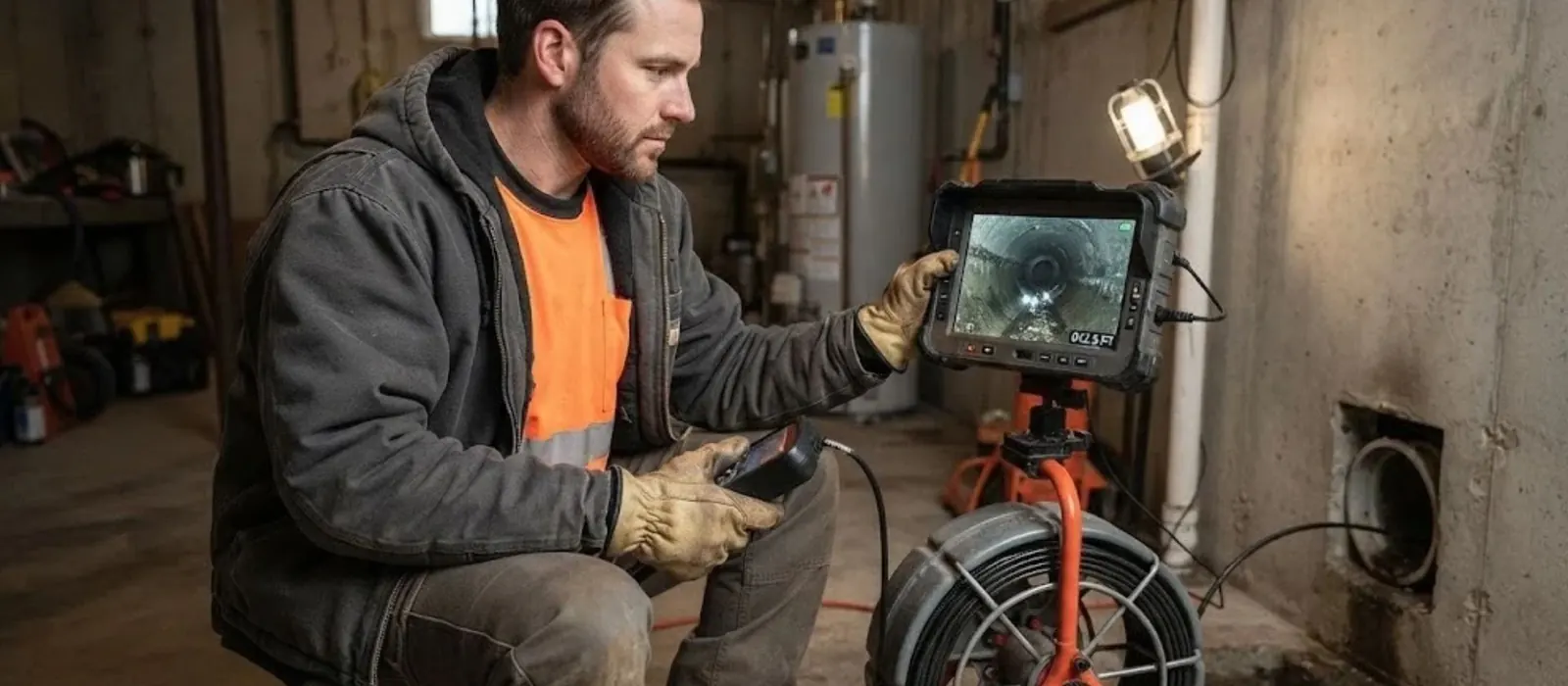
Why a standard inspection may miss it
A general home inspector looks at the visible parts of a house. The sewer lateral runs underground and is out of sight. Without a camera, damage inside it can hide until after closing.
A camera inspection runs a small waterproof camera from a cleanout through the line and records what it finds. You see cracks, roots, bellies and joints on video.
What the camera can reveal
These are the findings that change a buying decision.
Root intrusion
Roots in the line point to open joints and recurring backups.
Cracks and offsets
Damaged or shifted pipe that may need repair or replacement.
Bellies
Sags that hold water and solids.
Scale or heavy buildup
Narrowing from years of deposit.
Turning findings into decisions
Each finding leads to a conversation with the seller.
| Finding | Typical response | Where to read more |
|---|---|---|
| Clean pipe | Proceed | None needed |
| Roots only | Ask for cleaning credit or a repair plan | Sewer line cleaning |
| Cracks or offsets | Negotiate repair cost | Sewer line repair |
| Collapse | Major negotiation or walk away | Get repair quotes first |
Have the recording and the report ready for your agent.
How to order one
Timing matters during an inspection period.
Ask the seller for access
Locate the cleanout, or explain that the plumber may open a vent.
Book the camera
Schedule during the inspection period so findings can be used.
Share the video
Give the recording to your agent and, if needed, to a repair contractor for quotes.
What the inspection does not cover
A camera shows the pipe from the cleanout to the connection. It does not show the supply lines or the inside of walls. Water supply problems are found with leak detection tools, a different type of inspection.
It also cannot predict future damage. A clean pipe today may still be root prone if trees stand close. The inspection tells you the present condition.
Cost versus risk
An inspection costs far less than most sewer repairs. The price depends on line length, access and whether cleaning is needed first. Compare that to a full lateral replacement, and the choice is clear for older homes.
How to read the camera report
A useful report gives you the length of the run, the pipe material when it is visible and the location of each defect, measured from the cleanout. It notes cracks, offsets, roots and standing water. It should also say what the camera could not see, such as a section blocked by debris.
Ask for the video file as well as the summary. A repair contractor can watch the same footage and give you a quote without a second visit, which is faster and cheaper during an inspection window.
Timing the inspection
Schedule the camera visit early in your inspection period. If the video shows damage, you need time to get repair quotes and ask the seller for a credit or a fix. A finding that arrives on the last day leaves little room to negotiate.
Tell your agent what you plan to do. Agents deal with these requests often, and they can put the repair request in writing the right way.
What to do with the findings
A clean report is simple: proceed. A report with roots or minor offsets leads to a conversation. Ask for a credit that covers a cleaning and, where needed, a repair estimate. A report with cracks, a collapse or a large belly leads to a bigger conversation, and sometimes a price renegotiation.
Get at least one repair quote before you negotiate, so you speak in real numbers. Your agent can take the video and the quote to the seller, who may prefer to fix the problem before closing rather than lose the sale.
Other hidden items to ask about at the same time
The sewer line is one of several out-of-sight systems.
- Water heater ageThe label shows the manufacture date. See water heater replacement.
- Supply pipe materialGalvanized or polybutylene pipe may need repiping.
- Shutoff valvesTest the main and the fixture stops for stiffness.
- Water pressureA gauge reading takes a minute.
Questions to ask the seller about the sewer line
A direct question can save an inspection. Ask whether the line has ever backed up, whether any work has been done on it and whether there are records. Sellers must disclose known defects in many cases, and a written answer is useful if a problem appears later.
Ask about the trees. Large trees close to the line increase the odds of root trouble. Ask about the age of the house and whether the plumbing has been updated. A house that was renovated in the past decade may have a new lateral, while a house that has not seen a plumber in forty years deserves a closer look.
Do not rely on conversation alone. A seller can be honest and still not know what is inside a pipe. A camera shows the facts, and an informed buyer can negotiate from them.
Keizer note: homes of the 1950s to 1970s
The City of Keizer reports that development began in earnest in the 1950s and that homes were built on former orchards and berry fields through the 1970s. A home from those years may have an original lateral, so it is a strong candidate for a camera check at purchase.
Marion County and the City of Keizer share the permit process, and the Building Department at (503) 856-3440 can tell you about permits for any repair that follows. If you are buying near Salem or in Woodburn, the same advice holds.
Buyer inspection questions
Usually under an hour for a standard home, longer if the line needs cleaning first.
Usually the buyer, though you can ask the seller to cover findings that need repair.
Yes. The video and written findings back up a request for credit or repair.
We have not found a city requirement. Ask the City of Keizer and your agent.
Most sellers agree during an inspection period. If the cleanout is hard to find, the plumber can often use a vent or a toilet.